


“Practical” and “sentimental” are not useful gift specifications until you translate them. A practical partner might want a daily-use object with a personal reference. A sentimental partner might want a small group of photographs, rather than every possible keepsake. The personalized long-distance initials mug and three-photo Love You Forever light can serve those preferences without implying that one person cares more.
If you are choosing an exchange together, agree on the kind of object each person would welcome and keep the personal details as the surprise. This preserves enough direction to buy accurately while leaving room for a considered initial pair, photograph selection, or meaningful date.
The Missing You mug says “Miles apart but close at heart,” so this particular mixed pair assumes that you still live apart. The photo light’s continuing-love message can also fit a shared home, but the mug should not be chosen for a reunited couple merely because it is practical.
What does practical mean to this person?
Ask what gives the object value in their day. “I want to use it” is more actionable than “I am not sentimental.” It points toward a wanted cup without ruling out affection, photographs, or personal meaning in principle.
A useful object can be deeply personal. A decorative object can also be a carefully considered purchase. The difference is what gives the owner pleasure: reaching for something during a routine, or noticing a memory in the room.
Start by describing those pleasures specifically. “Practical” might mean a partner dislikes objects that only sit on display, not that they dislike romance. “Sentimental” might mean they enjoy looking at photographs, not that they want every available keepsake. These labels are useful only when they lead to the right selection.
For a complementary exchange, avoid using price, size, or visual complexity as a measure of affection. Two thoughtful purchases do not have to communicate in the same way. Their balance comes from how well each fits its recipient.
The initials mug’s tradeoff is limited storytelling. The mug does not give several photographs or a detailed relationship history a prominent place. If the practical partner actually likes one particular couple image on everyday items, a photo product may deserve consideration instead. Choose this mug because the symbolic design fits, not because practicality supposedly rules out pictures.
What makes the mug meet that preference?
The initials should be a design they enjoy, not a default assigned to the person who supposedly cares less about memories. Select the capacity with the same attention you give the other partner’s image choices.
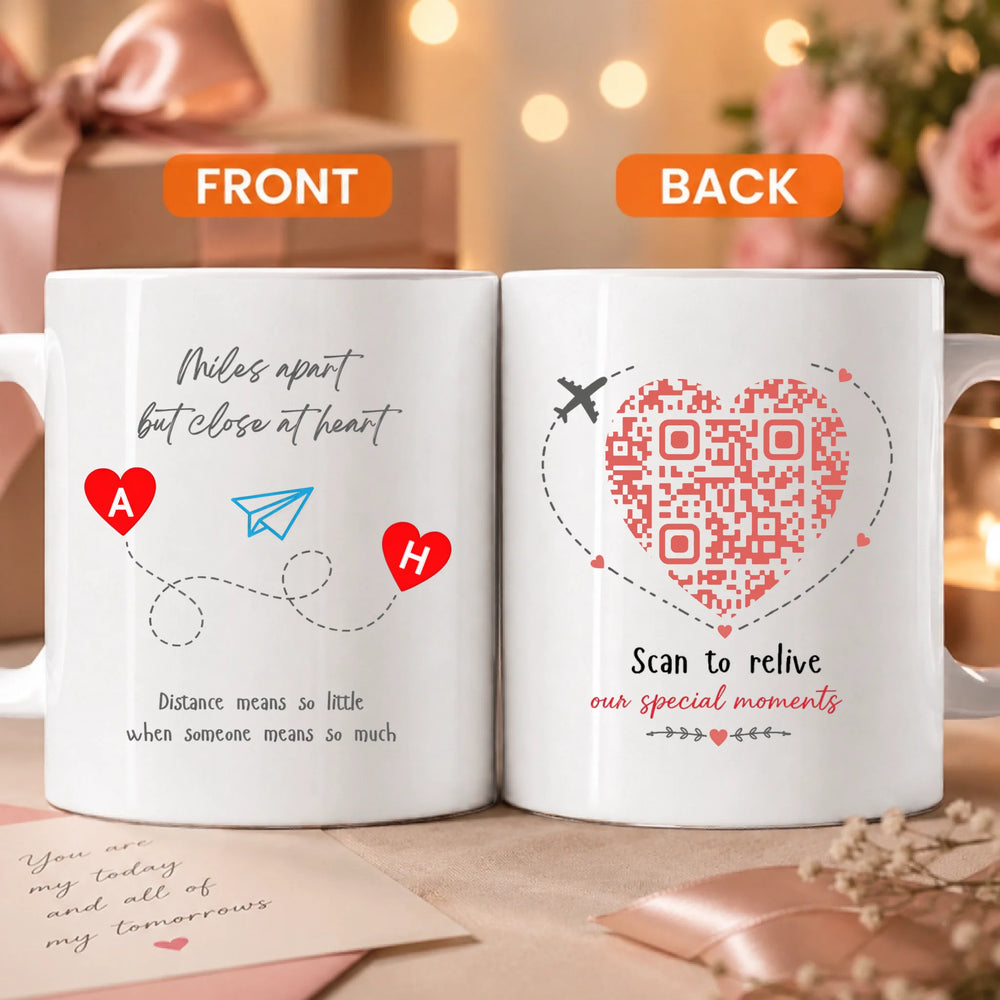
The Missing You mug places initials inside heart markers, accompanied by a paper airplane and dotted travel line. The imagery makes the long-distance connection visible on a familiar white ceramic cup. It gives an everyday item a relationship-specific detail without requiring a separate place to display it.
Choose it for someone whose coffee or tea routine is already part of their day. That routine might happen while reading the morning news, taking a work break at home, or talking with you at the weekend. The gift succeeds when the cup feels natural in that activity.
There are 11 oz and 15 oz options. This is a consequential choice for the practical partner: the right capacity can determine whether the mug is used regularly. Match their normal serving rather than choosing the larger version to make the gift seem more substantial. Heldinside describes the mug as microwave and dishwasher safe.
Initials are an appropriate kind of personalization here because they add recognition without changing the cup's purpose. Your partner can understand the private reference quickly and then carry on using it. The affection is available without requiring them to stop and examine a display.
Personalize the Missing You mug
What does sentimental mean to the other person?
A person who keeps photographs may enjoy a carefully edited three-image set. That does not mean they want a decorative object anywhere there is a gap. The collage should offer a memory experience they actively value.
The Love You Forever memory night light makes shared pictures the main attraction. The retailer illustration shows a three-photo collage with a romantic heading; names and a special date add personal context. It is a suitable choice for someone who already enjoys printing, arranging, or returning to photographs.
The collage allows more than one kind of moment to appear. A relaxed image can sit beside a special-occasion picture, giving the display a fuller sense of the relationship. Choose a group that belongs together emotionally, even if the pictures were not taken on the same day.
Its main tradeoff is that it requires display space and power. It is not automatically the stronger romantic gift simply because it has more personal material. For a partner who enjoys memory displays, that material is the reason to choose it. For someone who keeps every surface clear, it may become an obligation.
What makes the light a considered purchase?
Use a group of images with a shared reason to belong together. The mug can echo that reason through the same people’s initials without being forced to carry the collage’s entire visual story.
The light has an optical acrylic panel in a natural wood base and uses USB power. Size choices are 5 × 7 and 6 × 8 inches. Warm White and 7 Colors are the listed light-color options. Pick the display size and color option for the room where your partner will enjoy it, not merely to make the second gift seem different from the first.
The smaller physical format encourages close viewing. A bedside table or personal dresser can be a better location than somewhere the recipient only passes at a distance. The photos, names, and date deserve enough attention to be recognizable.
A good pairing can use the same relationship reference in different forms. The initials on the mug represent the people whose names appear on the light. The light's photos might come from the visit during which you began a shared coffee habit. The connection can be meaningful even when it is not visually identical.
There is no need to force the mug to carry the light's entire story. Initial-heart personalization is a smaller language. Let it do its job, then use a note to explain how the two objects belong together.
For example, you could frame the exchange around “the ordinary parts we love.” The mug refers to a familiar drink; the collage shows relaxed shared moments rather than only formal celebrations. That creates a coherent pair without pretending the products were sold as a coordinated bundle.

How much can you discuss without losing the surprise?
One person can choose the category while the giver chooses the detail. That division avoids guessing the entire gift and avoids requiring the recipient to design every part themselves.
If you are choosing gifts together, agree on the kind of object each person would welcome and leave the personal details as the surprise. One person can choose “something I will use with my morning coffee,” while the other chooses “something with our photographs for my room.” That is enough direction to make the purchases thoughtful.
If you are selecting both yourself, rely on habits you already know. A cupboard full of actively used cups and a collection of printed photos offer more useful evidence than a stereotype about who should receive practical or romantic presents.
You also do not have to buy both at the same time. The pair is an idea for two recipients, not a reason to add an unnecessary second item to a single gift occasion.